Best Hinge Opening Angle for Corner Cabinets (105° vs 165° vs 170°)
Choosing the best Hinge Opening Angle for Corner Cabinets (105° vs 165° vs 170°) often determines how functional your kitchen storage feels on a daily basis. Many homeowners struggle with doors that block access or hit adjacent cabinetry because they selected the wrong hardware during installation. Understanding the difference between these specific opening degrees ensures you maximize your reach into deep, awkward corner spaces.
By identifying which hinge suits your layout, you can effectively prevent frustration and ensure smooth operation for years to come. This overview provides the clarity you need to pick the right component for your specific cabinet configuration without the guesswork that usually plagues DIY kitchen projects.
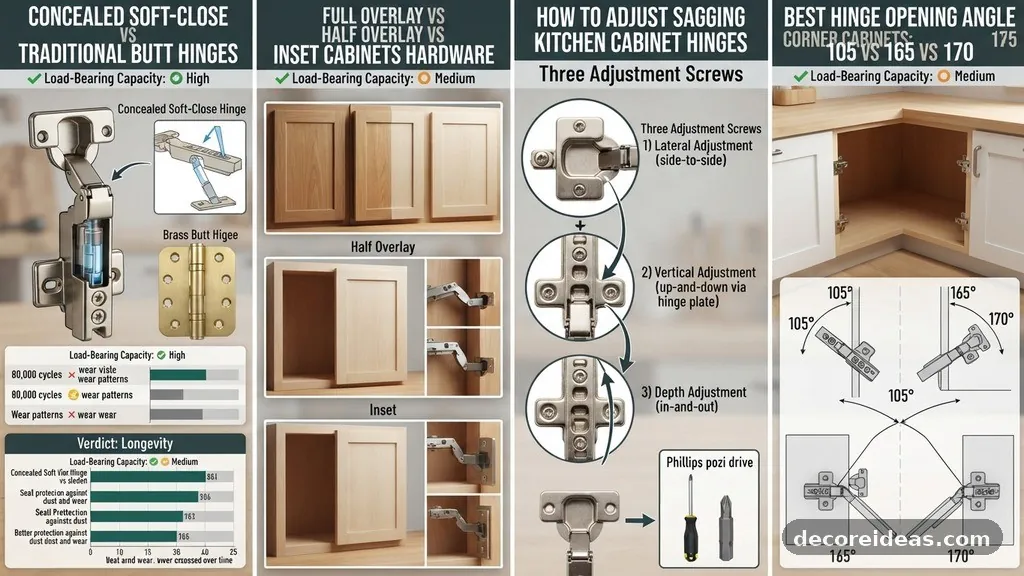
The short answer is that a 170-degree hinge is generally the best Hinge Opening Angle for Corner Cabinets (105° vs 165° vs 170°) if you require full, unobstructed access to the interior. While 105-degree hinges are standard for flat runs of cabinets, they are almost always insufficient for corner units because they prevent the door from folding back far enough.
A 165-degree hinge serves as a high-quality alternative that also provides a wide clearance, though the 170-degree option offers the maximum possible swing. If your goal is to pull out drawers or reach into a lazy susan without the door getting in your way, you should prioritize the widest angle available.
Why Standard 105-Degree Hinges Often Fail in Corners
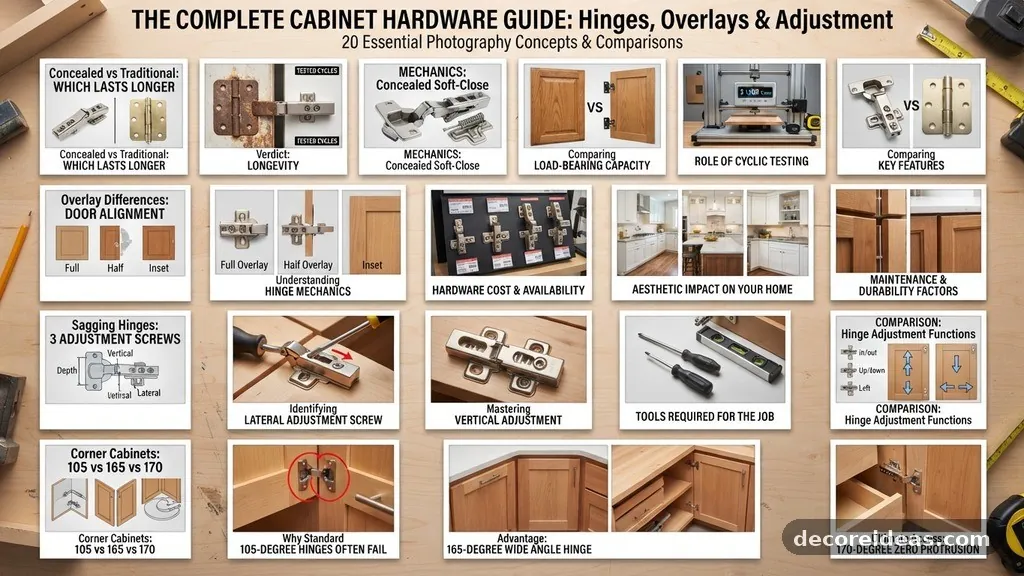
Most standard cabinetry comes equipped with 105-degree hinges because they are cost-effective and perfectly adequate for standard doors. However, these hinges are designed for linear runs where doors do not need to clear adjacent frames or perpendicular drawer fronts.
When you place a 105-degree hinge on a corner cabinet, the door stops abruptly before it can fully clear the opening. This creates a bottleneck that makes it physically difficult to slide out shelves or retrieve large pots and pans.
The limitation of the 105-degree hinge lies in its mechanical geometry. Because the pivot point is restricted, the door remains angled into the opening, effectively shrinking the usable width of your cabinet.
You might find that you can open the door just enough to reach inside, but the edge of the door will constantly bump against your hand or the item you are trying to pull out. In a kitchen, where efficiency is paramount, this constant interference becomes a major annoyance.
Furthermore, these hinges often force you to open doors in a sequence. You might have to open one door completely before you can even touch the handle of the adjacent one.
This lack of independent access is a hallmark of poor hardware selection. If you are renovating a kitchen, you should avoid using 105-degree hinges on any cabinet that meets another at a 90-degree angle.
Understanding the 165-Degree Hinge Advantage
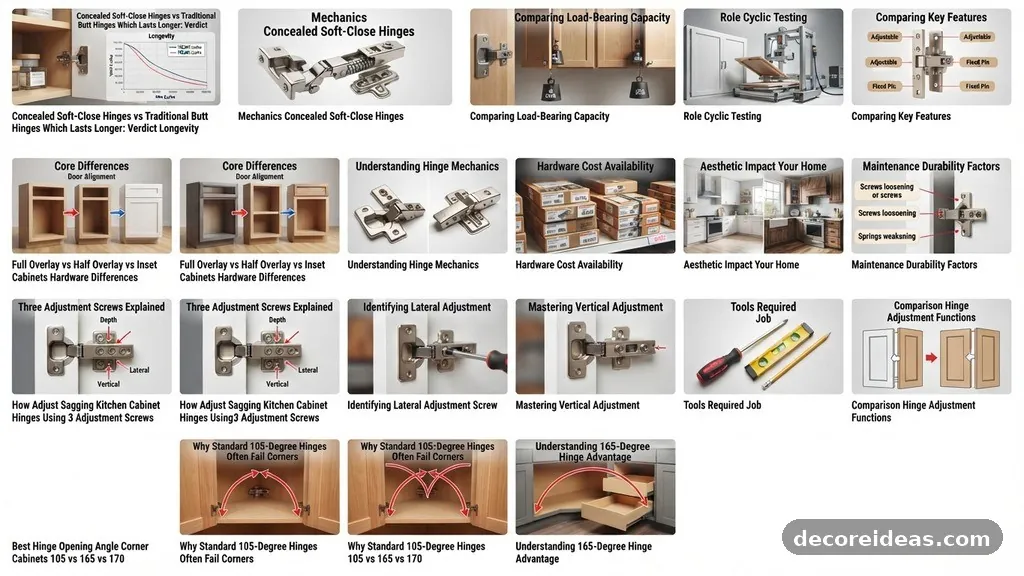
Moving up to a 165-degree hinge provides a significant upgrade in user experience for corner installations. This type of hinge allows the door to swing well past the 90-degree mark, effectively folding it back against the side of the cabinet carcass.
By tucking the door out of the way, you create a clear path to the interior storage. This is particularly useful in tight galley kitchens where every inch of clearance counts.
Many professional installers prefer 165-degree hinges because they strike a balance between performance and compatibility. They are widely available from major brands like Blum, which sets the industry standard for cabinet hardware.
These hinges often feature integrated soft-close technology, ensuring that even a heavy cabinet door closes gently rather than slamming. The mechanical design of these hinges is robust enough to handle the weight of larger doors often found on pantry or corner units.
When you install a 165-degree hinge, you aren’t just changing the angle; you are changing the entire flow of your kitchen. The door no longer acts as a physical barrier to your workspace.
This allows for the installation of pull-out organizers or internal drawers that would otherwise be impossible to use. If your cabinet layout allows for a 165-degree swing, it is usually a superior choice over the more restrictive 105-degree version.
The Maximum Clearance of 170-Degree Hinges
For those who need the ultimate in accessibility, the 170-degree hinge is the gold standard. It offers the widest possible opening angle, allowing the door to swing almost entirely clear of the cabinet opening.
In many cases, the door will sit flush against the side of the adjacent cabinet, leaving the entire cavity wide open for you to use. This is essential for corner cabinets that house lazy susans or heavy-duty pull-out trays.
The increased angle of the 170-degree hinge is achieved through a multi-pivot linkage system. This complex movement allows the door to clear the edge of the frame without hitting the neighboring cabinet face.
While these hinges are slightly more expensive than their 105-degree counterparts, the long-term benefit is worth the investment. You are essentially paying for the ability to use 100% of your cabinet’s internal volume without obstruction.
It is important to check your specific cabinet box construction before purchasing these hinges. Because they swing so far, they require specific mounting plates and enough clearance on the outside of the cabinet to accommodate the door’s movement.
If you have decorative trim or molding near your corner cabinet, ensure the door won’t strike it when it reaches its full 170-degree extension. Proper planning here prevents structural damage to your finishings.
Comparing Hinge Specifications
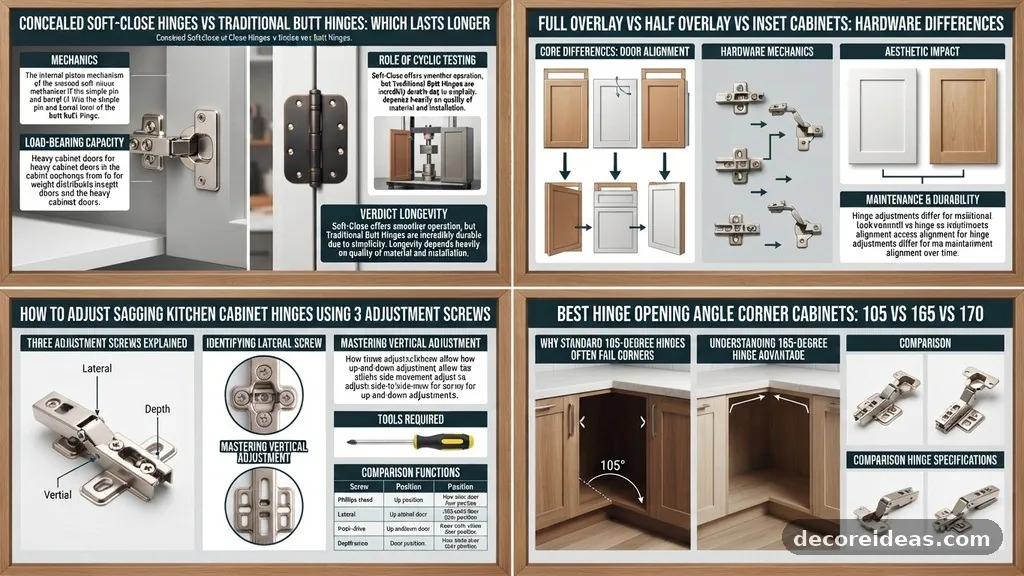
To make an informed decision, it helps to view the technical differences side-by-side. The following table illustrates how these different angles impact the functionality of your cabinet doors.
| Hinge Type | Opening Angle | Best Use Case | Clearance Level |
|---|---|---|---|
| Standard | 105° | Linear wall cabinets | Low |
| Wide Angle | 165° | Corner units / Pull-outs | High |
| Full Access | 170° | Maximized corner access | Maximum |
As shown in the table, the jump from 105 to 165 degrees represents a massive shift in utility. While the difference between 165 and 170 degrees might seem small on paper, that 5-degree variance can be the difference between a drawer sliding out smoothly and one catching on the hinge arm. Always prioritize the widest angle that your specific cabinet frame can accommodate.
Hardware Compatibility and Mounting Plates
Choosing the correct hinge is only half the battle; you must also ensure the mounting plate is compatible. The mounting plate is the component that attaches the hinge to the cabinet wall.
Different angles require different plate depths to ensure the door sits square when closed. If you mix and match parts from different manufacturers, you may find that your doors do not align correctly, leading to gaps or rubbing.
It is highly recommended to stick with a single brand for your hinges and plates. If you select a 170-degree hinge from a specific manufacturer, use their matching mounting plates to ensure the geometry works as intended.
Many modern systems are modular, meaning you can swap out the hinge body while keeping the plate fixed to the wall. This makes future adjustments or upgrades much easier to manage.
Pay close attention to the overlay type as well. Some hinges are designed for full overlay doors, while others are for partial overlay or inset doors.
A hinge with a 170-degree opening angle will not work if the hinge arm geometry does not account for the thickness of your door. Always consult the technical documentation provided by the manufacturer to verify your door thickness and overlay requirements.
Impact of Soft-Close Mechanisms
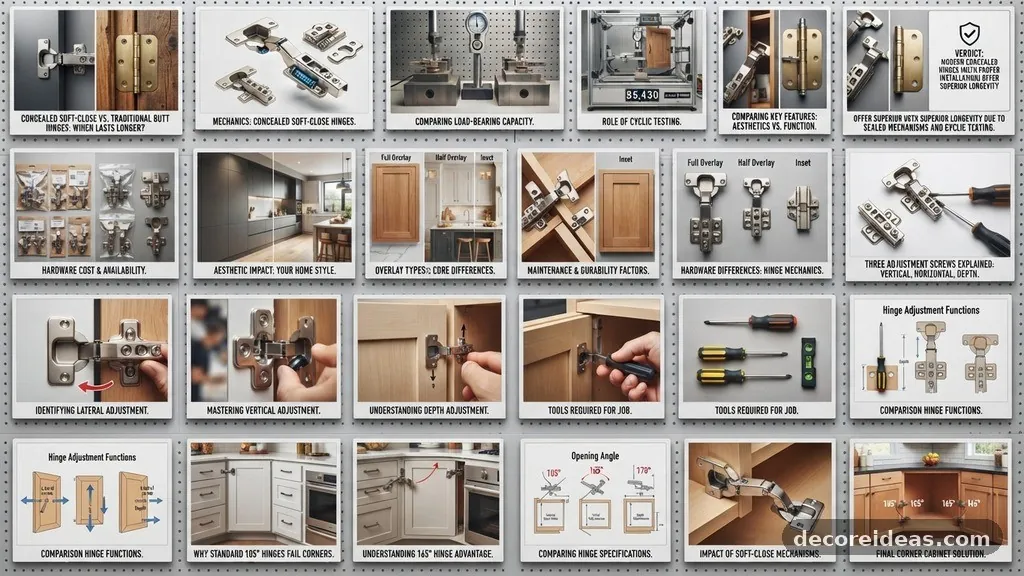
Modern kitchen design almost exclusively uses soft-close hinges. These mechanisms use hydraulic dampeners to slow the door’s momentum during the final inches of travel.
When selecting a 165-degree or 170-degree hinge for a corner cabinet, look for versions that include this feature. The weight of larger corner cabinet doors can cause them to slam shut with significant force, which can damage the frame over time.
Soft-close hinges also prevent the door from bouncing back after it has been closed. This is particularly important for corner cabinets where the doors are often large and cumbersome.
By ensuring the door settles into place quietly and firmly, you protect both the cabinet finish and the hinge hardware itself. Even if you choose a slightly more expensive hinge, the inclusion of soft-close technology is a feature you will appreciate daily.
Do not be tempted to buy cheap, non-branded hardware for these critical applications. Corner hinges are under more stress than standard hinges due to the wider swing and the extra weight they often carry.
High-quality hinges will have more durable internal springs and better dampening oil, ensuring they maintain their performance for many years. Saving a few dollars on hardware often leads to sagging doors that require constant adjustment.
Factors Influencing Your Selection
Beyond the degree of the hinge, consider the physical layout of your kitchen. If your corner cabinet is adjacent to a dishwasher or a wall, you might have limited space for the door to swing.
A 170-degree hinge might be technically possible, but if the door hits an obstruction at 150 degrees, you won’t get the full benefit. Measure your available clearance before you finalize your purchase.
Consider the weight and material of your doors as well. Solid wood doors are significantly heavier than laminate or MDF panels.
If you have heavy solid wood doors, ensure your chosen hinge is rated for that weight. Some wide-angle hinges may require an additional hinge in the center of the door to prevent sagging over time.
Think about the interior accessories you plan to install. If you are adding a pull-out spice rack or a lazy susan, the hinge must clear the path for these items.
Sometimes, a slightly less wide hinge is acceptable if your internal storage doesn’t require a full 170-degree swing. Always map out the swing path of your door using a piece of cardboard to visualize exactly where it will end up.
Common Installation Pitfalls
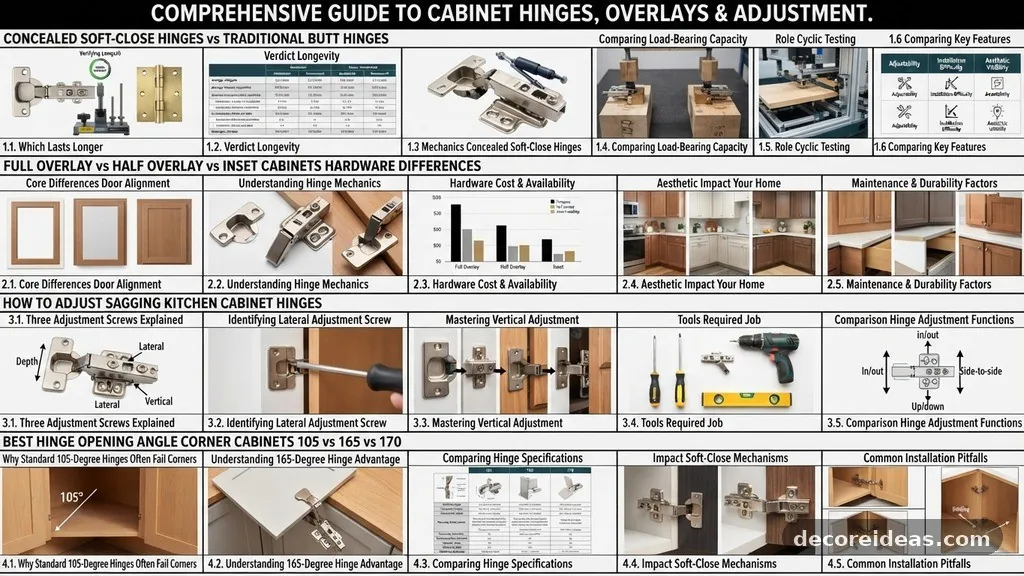
One frequent error during installation is failing to account for the door’s “throw.” As the door opens, the hinge arm moves into the interior space of the cabinet.
If you have a shelf installed too close to the hinge, the hinge arm might strike the shelf, preventing the door from opening. Always check the manufacturer’s clearance diagrams to see how much space the hinge arm requires inside the cabinet.
Another issue is mounting the plate at the wrong depth. If the plate is set too far back, the door will rub against the adjacent cabinet frame when you try to open it.
If it is set too far forward, the door will not sit flush when closed. Take the time to use the adjustment screws found on the hinge arm to fine-tune the door position after installation.
Don’t ignore the importance of a level cabinet box. If your cabinet is slightly out of square, the hinge will struggle to keep the door aligned.
Use shims during the initial installation of the cabinet box to ensure everything is perfectly level and plumb. It is much easier to fix the box alignment before the doors and hinges are attached than it is to compensate for a crooked box using only hinge adjustments.
Benefits of Professional Hardware
Investing in reputable brands offers more than just a peace of mind. These companies provide detailed installation guides and online resources that help you troubleshoot any issues.
They also offer a wide range of accessories, such as hinge covers and dampener caps, that give your cabinets a finished, professional look. Using recognized products also makes it much easier to find replacement parts if a hinge ever fails.
Professional-grade hinges are also designed with longevity in mind. They undergo rigorous testing to ensure they can withstand tens of thousands of opening and closing cycles.
This is particularly relevant for the high-traffic areas of your kitchen, such as corners where you might be accessing ingredients or tools multiple times a day. You want hardware that remains tight and responsive throughout the life of the kitchen.
Consider the ease of adjustment. High-quality hinges feature independent screws for depth, height, and lateral adjustment.
This allows you to tweak the position of the door in three dimensions without having to remove it from the hinge plate. This level of control is vital for achieving that perfect, uniform gap between your cabinet doors.
FAQ: Common Questions About Cabinet Hinges
What does a 105-degree hinge actually limit in a corner cabinet?
A 105-degree hinge limits the door to a relatively narrow opening. In a corner, this means the edge of the door remains in front of the cabinet opening, acting as a physical obstruction that makes it difficult to slide out internal shelves or access large items stored in the back.
Can I replace my old 105-degree hinges with 170-degree hinges?
In many cases, yes, provided the mounting plate hole pattern matches or you are comfortable drilling new pilot holes. You must verify that your door thickness is compatible with the 170-degree hinge geometry and that there is sufficient space outside the cabinet for the door to swing fully open.
How do I know if a 165-degree hinge is enough?
A 165-degree hinge is usually sufficient for most corner cabinets, especially those with lazy susans. If your cabinet opening is standard and you don’t have deep pull-out drawers that require absolute maximum clearance, 165 degrees will provide a significant improvement over the standard 105-degree hinge.
Are soft-close hinges worth the extra cost?
Yes, soft-close hinges are a worthwhile investment for any kitchen. They prevent slamming, protect the cabinet finish, and keep the door securely closed. The added cost is minimal when compared to the overall price of a kitchen renovation and the long-term wear and tear they prevent.
Do I need an extra hinge for heavy corner doors?
If your door is taller than 40 inches or made of heavy, solid wood, you should consider adding a third hinge. This prevents the door from sagging under its own weight and ensures the hinge mechanism operates smoothly over time. Check the manufacturer’s weight rating for your specific hinge model.
Final Thoughts on Choosing Your Hardware
Selecting the right hardware is a critical step in finalizing your kitchen design. When considering the best Hinge Opening Angle for Corner Cabinets (105° vs 165° vs 170°), always lean toward the wider options if your space permits.
While the standard 105-degree hinge is fine for flat runs, it rarely provides the accessibility needed for corner units. By opting for 165-degree or 170-degree hinges, you ensure that your storage space remains fully functional and easy to access.
Take the time to verify your cabinet’s structural requirements and choose a reputable brand to ensure long-term performance. Proper installation and adjustment will yield a kitchen that is both beautiful and highly efficient.
If you are still unsure about which model to choose, checking the technical specifications for your specific cabinet brand is the best next step. Enjoy the improved access and smooth operation that the correct hinge angle provides for your home.